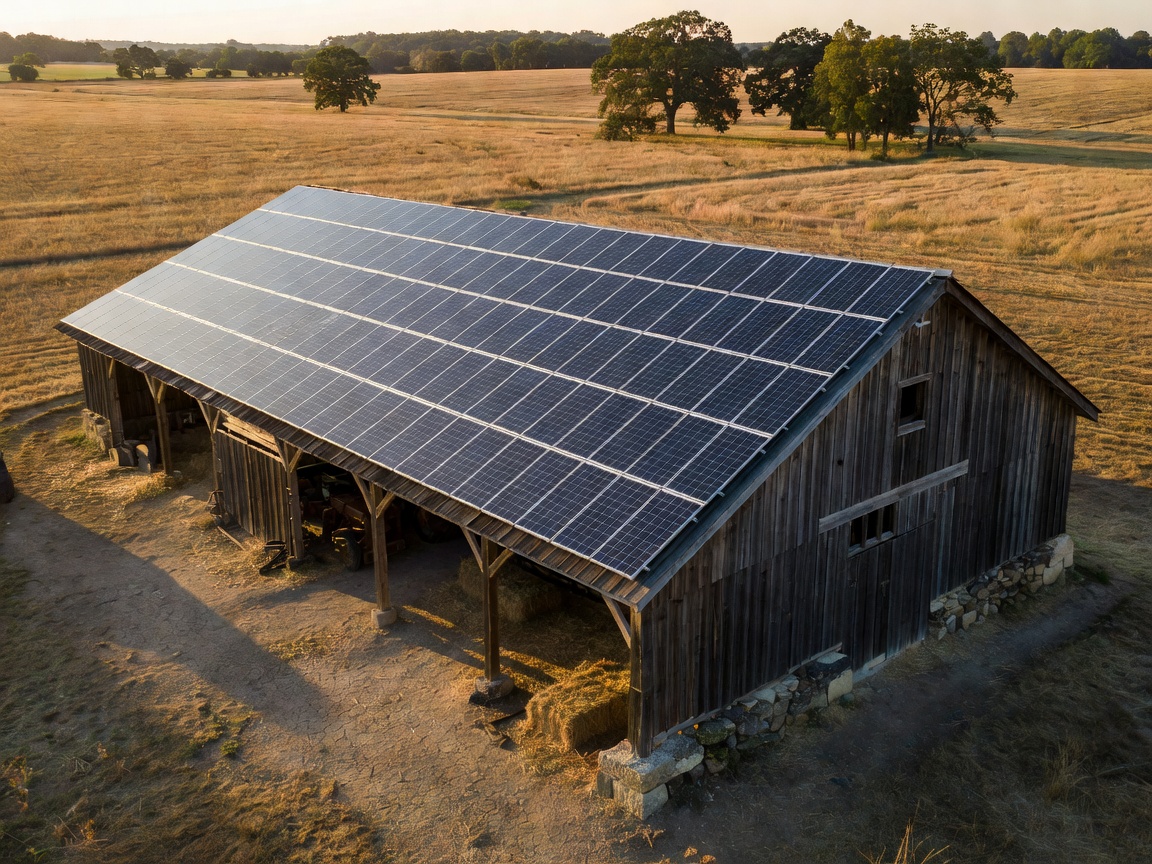
Agricultural rooftops can offer useful space without taking land out of production. Ground-mounted systems may provide a different orientation or expansion path, but introduce land-use, access, drainage and planning questions. Neither format is automatically suitable.
Start with the site
Record roof dimensions, pitch, orientation, shading, condition and access. A roof that appears large may have unusable areas around edges, vents, skylights or maintenance routes. Structural suitability requires appropriate professional review; visible condition alone is not enough.
Ground-mounted possibilities need their own assessment. Consider land function, machinery movement, fencing, drainage, soil conditions, visual impact and future field use. Do not assume that open ground is available simply because it is unused at present.
Match production with agricultural demand
Solar generation varies with daylight, season, weather and system orientation. Farm demand may also vary with milking, irrigation, refrigeration, ventilation, processing or workshop activity. The useful comparison is between the expected generation profile and the load profile, not between an annual generation estimate and an annual consumption total alone.
Where generation and demand do not align, planning may examine load scheduling, export arrangements or storage. These options depend on the property, equipment, network and current local requirements. No production, saving or payback figure should be assumed without a site-specific study.
Electrical and connection considerations
Existing switchgear, meter configuration, cable routes, protection arrangements and available capacity can affect the project. Connection requirements are determined by the relevant network operator and current local rules. A qualified electrical designer should define the technical route and coordinate required approvals.
Maintenance access must be preserved. Agricultural dust, birds, machinery, weather and future roof work should be considered when locating equipment and planning inspection. A system that blocks access to a roof or separates critical equipment from sensible service routes creates avoidable operational friction.
Selection criteria
- Usable roof or ground area
- Orientation, shading and condition
- Load timing and critical operations
- Electrical infrastructure
- Land-use and access constraints
- Maintenance and cleaning access
- Connection and approval pathway
- Future expansion or building change
Advantages and limitations
Rooftop solar can use existing building footprints and place generation near some loads. It remains dependent on roof suitability and daylight. Ground-mounted solar may allow more deliberate layout and access, but can compete with land use and require additional civil or planning considerations. Both formats require proper design, documentation and qualified installation.
Short checklist
- Map roof and ground options separately.
- Record shading, access and condition.
- Compare generation timing with farm demand.
- Review meter and connection information.
- Confirm local planning and technical requirements.
Related decisions
Begin with a farm energy assessment, then consider storage where timing is important. Efficiency measures may alter the required system size; the wider route is covered in renewable energy planning.
Have a site question?
Share the building type, operating pattern and constraint. We will help structure the next information request.
Contact the team